About us
Econec Association
A non-profit initiative developing and freely providing digital teaching materials for economics that respond to the new specifications in the curriculum.
Our mission
Econec is a non-profit initiative developing the educational infrastrucutre for new economic education in Switzerland and byond . We believe economics education should help students understand the world they live in, engage with complexity, and reflect on the social and ecological dimensions of economic life.
Our mission is to make that possible in everyday teaching practice by creating accessible, high-quality, and adaptable learning modules for upper secondary education.
Why this project matters
The new framework curriculum requires teachers to address not only core economic concepts, but also sustainable development, civic education, as well as the diversity of analytical approaches. Existing materials do not yet cover these expectations in a way that is both comprehensive and ready for classroom use.
Econec responds to this challenge by developing modules that are designed for direct use, while remaining flexible enough to fit different teaching styles, course formats, and student groups.
“The PEC 2024 requires students to analyse economic development and its interactions with society and ecology, and to assess the limits of growth.”
— Swiss Framework Curriculum (CDIP, 2024)
Our vision for economics education
We see economics education as more than the transmission of isolated concepts. It should help students:
- Understand economic phenomena as part of broader social and ecological systems
- Work with multiple concepts, methods, and perspectives
- Recognise the limitations of economic frameworks
- Connect classroom knowledge to real-life issues
- Reflect on the ethical dimensions of economic choices and institutions
How we ensure quality
Quality assurance is central to the project. Each module goes through a standardised process:
- 1Scoping and curriculum alignment
- 2Production of teaching and support materials
- 3Pedagogical and disciplinary review
- 4Usability review with teachers
- 5Linguistic proofreading and terminological consistency
- 6Final validation against a clear Definition of Done
A module is only considered ready when it offers explicit PEC alignment, clear learning objectives, acceptable teacher preparation workload, documented sources, linguistic quality, and compatibility with selective classroom integration.
Project phases
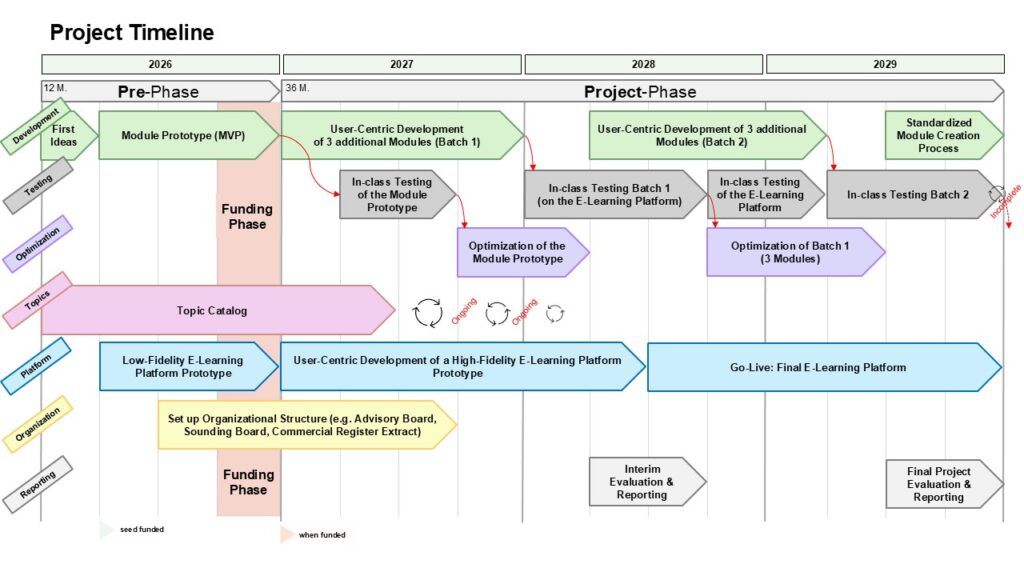
~1 year
Pre-Phase
- Developing a beta verion learning module in German, French and English
- Design a website for the project and the beta module
- Prepare for funding round
~3 years
Phase 1
- Establish a topic catalogue
- Develop 6 additional learning modules
- Go live with the learning platform
- Have all modules tested in real-world classrooms
Following Phase 1
Phase 2
If Phase 1 is finished successfuly the project will be continued !
- More modules
- Further institutionalization and professionalization
- Expand the team
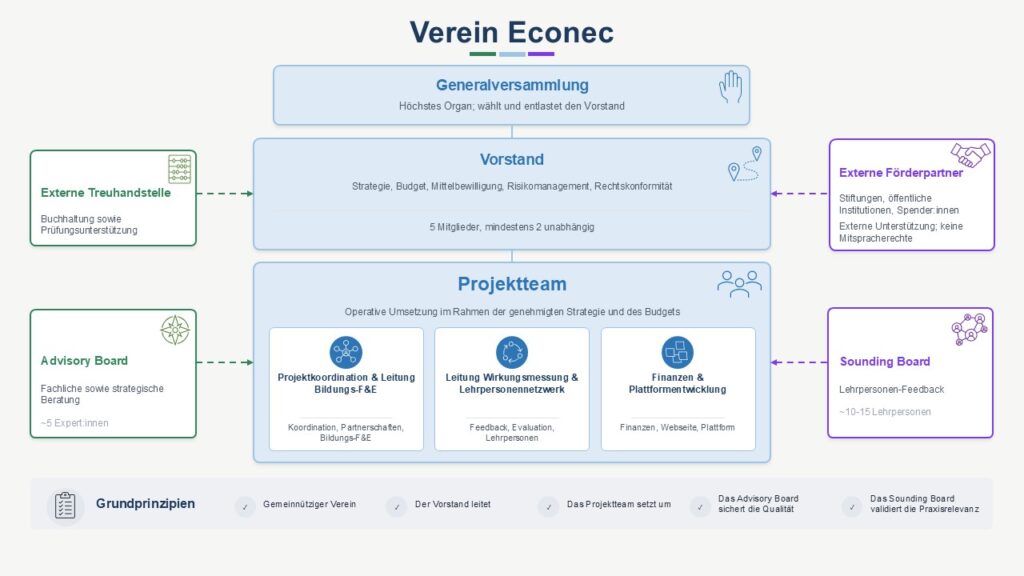
Organizational Strucutre
The team

Yannick Sottas
Project Coordinator & Head of Educational R&D
M.A
Yannick Sottas bringt Fachwissen in Wirtschaft, Bildung und curriculumsbezogener Projektentwicklung mit. Mit einem Hintergrund in Wirtschaftswissenschaften und einem Lehrdiplom in Wirtschaft und Recht arbeitet er an der Schnittstelle von Pädagogik, Forschung und Bildungsinnovation. Seine Erfahrung in Hochschule, Unterricht und Netzwerken der pluralen Ökonomik prägt die strategische Ausrichtung von Econec.

Christoph Fausch
Head of Impact Assessment & Teacher Network
M.A
Christoph Fausch brings experience in economics, innovation, user research, and education. His work combines data-driven analysis, service design, and teaching practice. At Econec, he leads impact assessment and supports the development of strong links with teachers and schools

Bathélémy Tripod
Strategy & Platform Creation
B.A
Barthélémy Tripod contributes expertise in political economy, sustainability, entrepreneurship, and digital product creation. His background in website creation, UI/UX, and educational reflection supports both the pedagogical development of the modules and the design of the platform experience
Help shape the future of economics education
Whether you are a teacher, expert, partner, or supporter, your perspective can help shape a stronger and more meaningful economics education.